Saturday, October 17, 2015

(day 4) Theodosius Walls

After taking a much needed respite at Mihrimah Mosque, we swung by to the nearby Theodosian Walls, mentioned briefly in this post.

Constantinople is situated on peninsula and surrounded by water on three sides; Emperor Constantine built a wall to protect the fourth side, the land portion. As the population of the city grew, the city boundaries needed to expand. Emperor Theodosius built a second set of walls (408-413 AD) during his reign.

These walls protected the empire from land attack by foreigners for centuries. In fact, they were never taken by a foreign power until the Ottomans came in 1453.

While none of the original Constantinian walls remain, parts of the Theodosian Walls are still intact and can be explored.

The walls aren't guarded or maintained, you can just climb right up, at your own risk of course.

Up in one of the wall's parapets, the highest point of the wall.
The walls, though crumbly, extend for quite a ways in either direction.

Imagine being an invading army and having to fight people shooting arrows at you from up here. Terrifying.
Ali wanted a picture, I told him he was an idiot to sit up there.

The proudly waving Turkish flag. I asked what the flag symbolized, according to one legend, the moon and stars were reflected in the (red) blood spilt by Turkish (Ottoman) soldiers during a battle, and so the sultan adopted this as his flag.

One part of the wall was pretty treacherous to climb. No handrails, and a practically vertical incline, with each step being just one foot's width deep. It was not bad going up but coming down was not fun.
One part of the wall was closed off, and someone had made a cat shelter that was just swarming with cats! At least 20.
This little baby kitty! Mrowr.
I really don't understand what this is for, I just hope the cats are able to leave when they want.

(day 4) Mihrimah Mosque (Mihrimah Sultan Camii)


So I'm doing these blog entries kind of out of chronological order, but post-dating them to be in the correct order. Kind of odd, I know, but there's no way I write fast and well enough to keep up with the pace of what I'm seeing. So I'm just picking my favorite things and writing about them first, but hopefully even after I get home I'll be able to get to the rest because I really want to document everything I saw.

********************************************************************************

After a long visit to the Chora Museum, Ali suggested that we see the Mihrimah Mosque. I didn't know much about the mosque, hadn't even dog-eared it on my travel map, but since it was nearby I figured sure why not.

A bit of history.

Mihrimah was the daughter of Suleiman (Suleyman) I, most commonly known as Suleiman the Magnificent. He had the longest-lasting reign over the Ottoman Empire, almost 50 years from 1520-66. His accomplishments extended to every aspect of ruling, including military conquests, instituting long-standing law reforms, and contributing as a patron to art and culture. Suleiman's ascension to the head of the Ottoman Empire heralded in a Golden Age for his people.

Suleiman had only 8 children total; 7 sons, and only 1 daughter, Mihrimah, a girl of purported beauty, born on March 21st, the day of the summer solstice, when day and night are equal. The name Mihrimah actually means sun-and-moon, as a nod to this noteworthy birthday. As a favorite daughter of the sultan, she commanded a surprising and unprecedented amount of political power as a woman, and throughout her lifetime made many contributions to the arts.

Of course, as daughter to the sultan she was not allowed to choose who she married, and was married off to Rustem Pasha, one of the sultan's grand viziers.

But of course, there's an interesting story here, which is the part I really want to tell. Mihrimah actually had two mosques built in her name, this one that I came to see, and another one in Uskudar (on the Asian side of the city) that is also known as the Iskele Mosque. Both were designed and built by her father's architect, the famed Mimar Sinan, the genius mastermind behind most of the empire's most famous buildings. Sinan is said to have loved Mihrimah, and although he could not marry her, he expressed his love by designing and then building this Mihrimah Mosque out of his own pocket, without palace approval. This mosque is unusual for a larger mosque in that it has only one minaret, representing Mihrimah as the one daughter of Sultan Suleiman. The other Iskele Mosque, however, has two minarets.

It's said that there is a significance to Mimar's placement of these mosques, as well as the number of minarets chosen. Legend has it that at sunset on Mihrimah's birthday, the summer solstice, you will notice that as the sun sets behind the only minaret of the mosque in Edirnekapi, the moon rises between the two minarets of the mosque in Üsküdar.

Ali told me that story and I thought it was quite nice. I love easter eggs.

I also really, really liked this mosque. To be perfectly honest, as grand and awesome as many of the mosques are, I cannot for the life of me tell them apart. I can kind of categorize them by number of minarets, but really, all look same. Inside and outside. Domes, minarets on outside, inside looks like someone vomited out a mess of geometric tiles. There's beauty in the detail but at first glance it's like oh, great, another mosque..........

This one is different though.
White walls, row upon row of beautiful stained glass windows that allow light to pour in and flood the room. A huge, sturdy but delicate chandelier dominates the room.

That's Ali sitting on the floor. Shoes off at the door, and I had to cover my head with a scarf and wear a long skirt wrap to cover my indecent legs, God forbid I have limbs.
There is much less ornamentation here than in other mosques, no tiles that I could see, and the artistic flourishes were tasteful and thoughtfully placed (in my opinion).

It really did look like a mosque designed for a woman. I don't know if that was the intention (I guess it was?) but it was very beautiful and delicate looking, and the unadorned white walls made it feel very pure and chaste. If I didn't know better I would guess that this is the castle Princess Peach is actually in.

I think this mosque also speaks more to my sensitivities because of the stained glass, which I really love, though it's much more of a Western design element. I asked Ali if stained glass was common in mosques, since I see it every now and then, here and there in Topkapi Palace, etc. He said no it is not common, but since Istanbul was at a crossroad of trade and very open-minded to new ideas, it adopted many different foreign notions.
The mihrab is the niche in the wall on the left side of the staircase, which indicates the direction of Mecca.
The staircase and platform is called the minbar. This is where the imam (priest) stands to give the Friday sermon (Jum'ah).
View of the dome.


(day 4) döner lunch at local lokantasi

After spending hours at the Chora Museum, trying to decipher the mosaics, I was starving. We decided to grab a quick lunch on the way to our next destination.

A street of colorful Turkish houses.

We stopped at a local lokantasi, which is something akin to a cafeteria or a deli, I guess.

There is usually a selection of pre-prepared foods, and you tell the owner which one you would like.

We didn't go for the lokantasi food though, and got döner instead (you can see the guy shaving off the meat). Apparently this area is a final stop for a lot of drivers (trucks, public transportation), who will then grab a quick meal here, so the food here is pretty cheap with no frills.
I took a picture of the döner but it didn't save. :( It was pretty plain-looking (and tasting) though, just a sandwich.

We got a cup of ayran to drink. I had been excited to try this since reading about it, it's a typical refreshing yogurt drink that people have with a meal, costs maybe 50cents.

Iiiiiittttt was gross. I hated it. Hate hate hated it. It's salty! I don't mind the yogurt taste, but with the salt it really tastes like a yak just squeezed it out or something. Yuck. I'm sure once you get used to it, or if you grow up drinking it it's delicious, but it wasn't my taste. :< I gave mine to Ali.

Shared my lunch with some kitties. This big fat one...

...and this little baby one! They look similar so I thought they were mom and baby, but the fat one kept hogging all of the food, and the little one was all skin and bones and couldn't compete. I had to throw a decoy piece of meat to the fat one and then throw another piece to this one further away. Which he promptly couldn't find. Poor little idiot probably isn't gonna make it...

Friday, October 16, 2015

(day 3) Topkapi Palace (Topkapi Sarayi)


Topkapi Palace was one of the major residencies for sultans of the Ottoman Empire for 400 years, about 2/3 of the empire's lifetime. It was built by Mehmed II, better known as Mehmed the Conqueror, the sultan who finally was able to achieve the conquest of Constantinople. Constantinople was an incredibly defensible city; based on geography alone, it is situated on a peninsula and surrounded by water on three sides, with the fourth side protected by a thick wall (the Theodosian walls, built by Emperor Theodosius). That, combined with the might of the Byzantine Empire ensured that the city had never been taken by force.

Enter Mehmed. Middle name "the", last name "Conqueror". With a name like that Constantinople didn't stand a chance.

Just kidding, The Byzantine Empire had been on the decline for the last couple of hundred years, and could no longer muster up a sizable force to defend its walls. Still, they had the formidable Theodosian walls, which had never been toppled, and the Byzantine Iron Chain stretched across the mouth of the Golden Horn to prevent naval forces from entering the city by sea.

As both sides geared up for battle, the Byzantines were approached by a Hungarian cannon maker, who had completed work on a huge cannon that he wanted to sell to the city. The Byzantines were like sweet, we hella want this cannon and will pay any price for it, only thing is, we have no money. Nonplussed, the Hungarian diplomatically offered the cannon to the other side. Large cannon obtained! They busted through the Theodosian Walls like the Kool-aid man, for the first time in Constantinople history, and thousands of troops poured through.

To solve the problem of the Iron Chain, Mehmed portaged his ships over land by means of brute force and a lot of manpower and entered the Golden Horn from the other side of the chain.

After a 7 week siege, Constantinople fell and the Byzantine Empire was no more.

Mehmed moved in and built Topkapi Palace right along the coast.

Hundreds of years later, thousands of tourists pour into his royal home and wait in long lines to gawk at structures and objects that they don't understand the historical significance of.

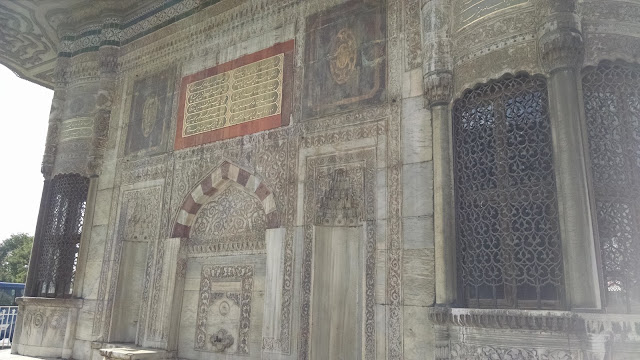
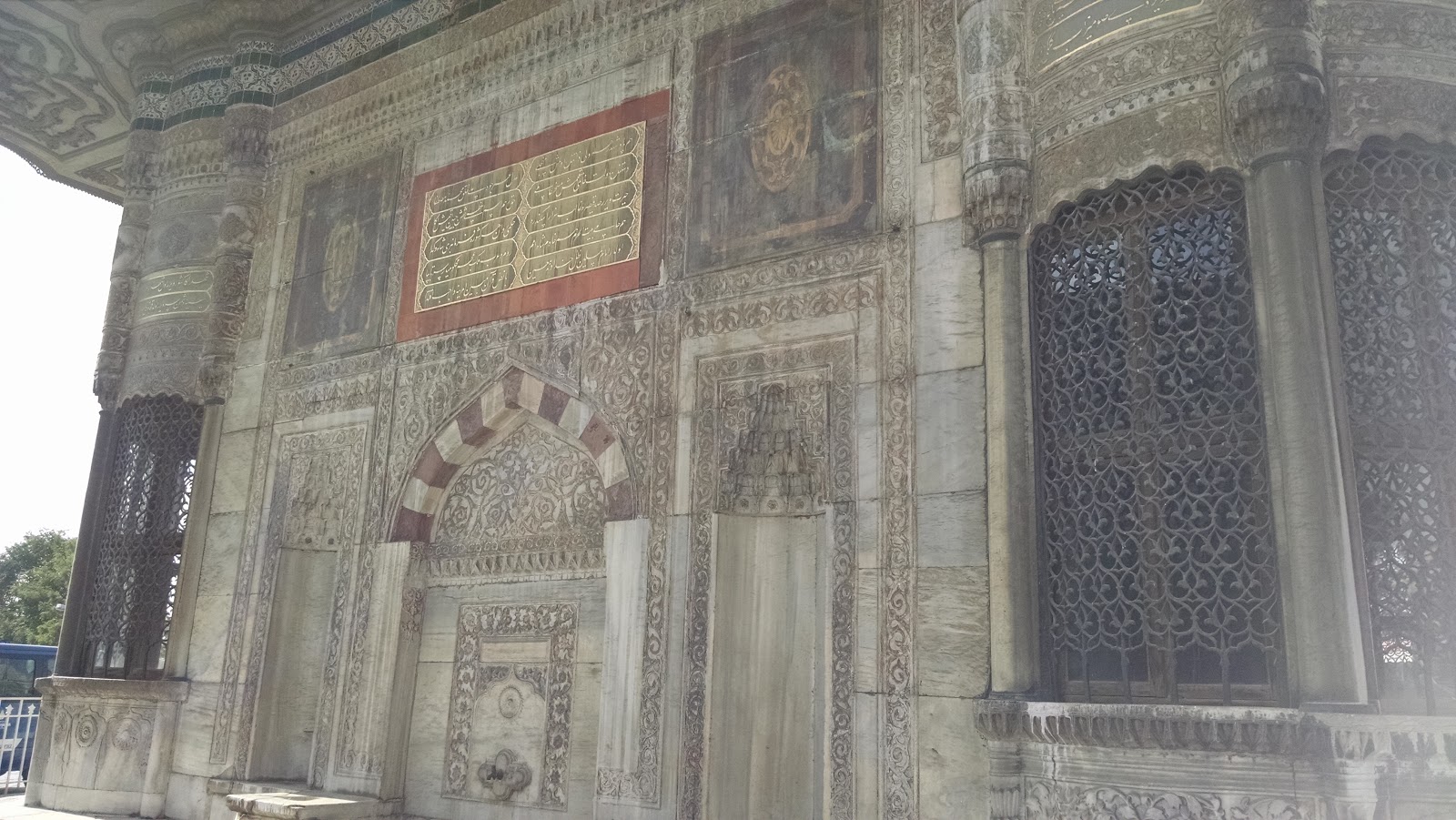
This little building sits right in front of the entrance to Topkapi Palace. I was really excited to see it because when I read about the function of these buildings it really helped transport me to a different time.

Back during the time of the Ottoman Empire, there were many dusty travelers coming and going by horse or on foot. Rich merchants, or nobles would build these little kiosks to offer passersby refreshments, on their own dime. It was a sort of charitable gesture, and in additional to providing a goodwill service to people, could maybe help boost the patron on the path to Heaven.

Most just served water, but more wealthy patrons might offer sherbet or juice.

This one, right outside Topkapi Palace, is quiet large, befitting a sultan's wealth and status.

Closer look.

The refreshments would be passed through these little windows. 
The main gate to the palace. Yes this is a really shitty picture that doesn't accurately represent the grandeur of the gate, but mentally mirror it over the y-axis and scale by 1000. It's really big!

The palace itself consists of four courtyards (mainly) plus many smaller buildings. The first courtyard is huge, the sultan and his entourage would ride in through this main gate to the first courtyard on horseback. As you go in deeper and deeper to the palace, the courtyards are smaller and more intimate, and fewer people are allowed into each one. The last courtyard is for private audiences between the sultan and his advisors.
If you were a giant, this is what Topkapi Palace would look like.
The first thing we did was rush back to the fourth courtyard, to wait in line to see the Treasury Room, before the line got too long. You aren't allowed to take pictures inside, but it's definitely worth a look. Jewel-encrusted everything-you-can-image, emeralds and rubies the size of quail eggs -- these are all treasures of the Ottoman sultans, kept here for safekeeping.

I'll just tell the two interesting stories I read about the imperial treasures.

One case holds a huge glittering diamond, surrounded by a double row of smaller diamonds. It is called the Spoonmaker's Diamond. As one legend tells it, a poor man is digging through some rubble and garbage when he finds a shiny stone. He haggled with a spoonmaker and was able to get three spoons in exchange for the rock. The spoonmaker takes it to a jeweler who recognizes it for what it's worth, and the 4th largest diamond in the world eventually makes its way up to the sultan, until finally it achieved its destiny by being beheld by me, Stephanie Lee, tourist #14802348.

There are other versions of the story, but basically the same theme where poor people get fucked and the 1% profit.

The second item is a beautiful dagger with three HUGE emeralds set into the pommel, and encrusted with diamonds down the length of the sheath. It was commissioned by sultan Mahmud as a gift to the shah of Persia, who had gifted Mahmud with the Peacock Throne taken from Delhi. Unfortunately while still en route to the shah, the shah was killed in a rebellion (assassinated, I guess), and so the Ottoman ambassadors brought the dagger back to the sultan. It was like BOGO throne and dagger. P good deal.

The line to see the Treasury.
Topkapi Palace is really, really huge. I seriously underestimated it. We were there for hours and hours and still barely grazed the surface of what was there, though I think we saw the highlights. I won't bore you with all the details, and I wasn't allowed to take a picture of most things. Among what I saw, other items of note included Moses' staff (I STILL cannot believe that that's true. I mean I guess it is but how can they have MOSES' STAFF? To me that's like saying oh, here in this case we have Zeus' thunderbolt, or, look over there, it's Mjolnir), the sword of the prophet David, a tooth and pieces of Muhammad's beard, as well as a footprint left by Muhammed. Sadly the significance of a lot of the Islamic religious artifacts was lost on me, since I don't know enough about the stories and background of the religion.

Of course, the sultan picked the best location for his palace, so the walkways around the edge of Topkapi Palace offer beautiful views of the sea. You can see across the Bosphorus Strait here, and it was really fun to see lots of activity happening on the water, large cargo boats, small ferry boats, all criss crossing their way across the water to different parts of Istanbul.

My travel companions, the one on the left (my right) is the Uzbekistan guy that works at the hostel, Ali, on the right is Kurt from Taiwan.
From another spot along the walkway. It was a sunny day and there was a nice breeze coming through, it was really comfortable.
As proof that I am in fact alive and writing this blog, me. Yes I hate taking pictures but Ali made me. 

He took like a thousand pictures and kept saying "Why do you hef no eyez in theze piktors? Open your eyez!" (Russian accent).

If only it were Monday, then he would have to obey my shirt and not talk.

No eyes. :(
Pretty roses and trees everywhere.
Each sultan, of course, wanted to leave their mark on Topkapi Palace, and so the palace structures were ever expanding, and increasing in number. Many of the structures we saw were kiosks or pavilions that were used as "chill spaces". 

Many had long red bed/couch/divans for lounging around.
And brightly lit from sun pouring through beautiful stained glass windows. 
The Terrace Pavilion, where they could watch sportive events or entertainment in the gardens.

Many of the rooms had a fireplace against one wall to keep the space warm. However, the room would be unevenly heated, especially hot near the fireplace and cold in the opposite corner. These portable heaters were filled with coals from the fire and moved out into the room to extend the sphere of heat.

This beautiful exterior wall adorn the most fair and delicate room of all, the Room of the Fair Maidens.

Haha just kidding. It's called the Circumcision Room. Precious royal centimeters were lost here.

If you look closely at the tiles to the left and right of the center panel, you can see an unusual sight in Iznik tiles. Hidden in the arabesques and flourishes are shapes that look like birds and beasts! In Islamic religion, it's forbidden to attempt to even recreate the semblance of a living form, since it's thought that only God has that right. That is why all of the decoration and designs on the interiors of mosques and such only contain geometric shapes and patterns. The artists here cheated a bit, they made bird-like shapes, but the "birds" don't have any eyes, which is what qualifies them as living things, so technically these tiles are Allah-approved. All-ahpproved. Heh heh.

I rather like the tessellations, though it makes most mosques look alike (to me).
And countless other kiosks/pavilions not pictured here.

Even though there was tons more to see, and tons of information to be absorbed, I was hungry and tired and no longer cared. We breezed through the (HUGE) palace kitchens (no photos allowed), the really really cool Clock Room (I wish I had spent more time there, huge collection of clocks), Weaponry Room (again, really really cool), Armory Room (suits of armor). We then did a run-through of what I had originally been most interested in seeing, the harem (coming soon to a blog post near you). I wish I'd had more energy to look around but I kind of raced through. Then finally exited to find lunch!

(Just a random kiosk). 

 Topkapi Palace! A huge museum of interesting artifacts and information. Definitely go see it.


(day 3) hidden palace


I made a new friend at breakfast this morning. He was eating breakfast near me and asked if I was the one that had left the hostel early this morning. Puzzled, I said no, I had been in the hostel all morning (it was only around 8:30am). Then I laughed and asked, "oh wait, did you see a short asian girl with blonde hair this morning? yah that wasn't me, there's two of us running around here". Last night at the terrace I had met a girl named Lily from Houston, she is Korean-American (but pretty American), is short, has very platinum blonde hair, and quit her job to go to Germany to see if she could pursue her dreams of a career in the music industry there. Very sweet girl, I enjoyed talking to her. But anyway it just goes to show that even seven thousand miles away from home you will still find people like you, and also, that you are not as special as you think. ;)

Anyway my new friend works at the hostel as the night shift front desk. He looked Hapa but spoke English with a Russian accent, but turns out he is from Uzbekistan! The only thing I know about Uzbekistan is that it is near many other -stan's (that gave me a lot of trouble during World History map memorization), and that it is notoriously hard to go visit. It is one of the hardest countries to get a visa, I'm not sure why.

His name is Ali, short for Ah-lee-sha (I don't know how to spell it, but it sounds like Alicia), and he's quite a character. He has lived in many other countries (Russia, Greece, Germany, ...) and has been in Istanbul for a year, but is going back home at the end of the month. Since he's leaving, he decided to go around and see all his favorite places in Istanbul again. So when I said I was going to Topkapi Palace he said he would come along, and I for one was very glad to have a buffer to ward away all the Turkish hawkers.

Joining our merry band of two was a Taiwanese guy living in Seattle named Kurt. I had chatted with him and Lily the night before. He's a PhD student that found a way to use water as a renewable energy source (albeit very inefficiently). I saw a picture of his "water battery" that was lighting a tiny LED light. Science. Bizarre.

Anyway we started off for Topkapi Palace, but Ali said he wanted to show us something first. We wound through some narrow streets, finally stopping at an innocuous looking restaurant. Walking past the entry gate and through the courtyard, we suddenly see this sign:

Followed by a set of rickety and dusty steps descending into the ground....

Ancient Roman ruins, hidden right under this street of restaurants! How cool is that. It felt super Indiana Jones.

Unlike the Hagia Sophia and other restored Roman buildings that I had seen, this one was still quite crumbly and the whole area being restored felt a little unsafe. I had wondered how much of these old buildings were original and how much were added during restoration, and this gives me a pretty good answer I think -- the stones and the structure are kept intact, but I think much of the mortar is replaced.

According to a plaque, this is the Great Palace (Palatium Magnum) whose construction was started by Constantine I, and Byzantine emperors continued to live here (among other palaces) until the 11th century (the start of the final decline of the Byzantine Empire).

The section of the palace we were in was where the foreign envoys were hosted.

They were still in the process of removing rubble out of the structure, which we heard through the flimsy and shuddering walls (the whole building was shaking a little).

The domed ceiling of one of the small chambers. It's amazing how good the construction is, I guess that's how it survived for 2000 years.

Through a narrow staircase. Like, look at that arch. It's so perfectly place it looks like machine work.
There wasn't a whole lot to explore and even though I'm sure it's safe, the threat of a cave-in felt all too real to me, so we didn't linger very long. It was really, super cool though. I was really thankful I met Ali that morning and that he showed us such a neat place, I certainly would never have stumbled across it on my own.